
Pegiat Literasi Publik, Pro Life Indonesia, Digital Journalism, Pengelola Jakarta News dan Ruang Biblika Kompasiana
 Lukisastra | Opa Jappy
Maraknya degradasi rasa bahasa di ruang literasi digital akibat banjir teks mekanis generator kecerdasan buatan. Ditambah tingginya tingkat pemborosan kata, pada karya banyak penulis, yang merusak estetika nalar dalam karya tulisan modern. Maka yang terjadi adalah hilangnya orisinalitas jiwa manusia pada hasil karya di Ruang Literasi Publik.
Oleh sebab itu, Ruang Sastra Modern Nusantara memerlukan fondasi, aturan baku, dan standarisasi untuk para Seniman dan Sastrawan di Indonesia; sekaligus pembeda dengan para penulis lainnya. Inilah latar kemunculan (wajib) Melukis dengan Kata-kata. Melalui pembiasaan yang tak lelah, Melukis dengan Kata-kata melahirkan Lukisastra.
Lukisastra bukan lukisan kata-kata, atau gambar aksara. Lukisastra merupakan identitas profesi, penulisan otentik, dan standar mutu gagasan di Ruang Digital. Lukisastra merupakan Seniman sekaligus Sastrawan, yang tak menggunakan kuas atau cat ketika menciptakan keindahan. Media utamanya adalah deretan kosakata yang dipilih dengan kepekaan estetika sangat tinggi. Sehingga bahasa tak selesai sebagai alat komunikasi verbal, tapi bertransformasi menjadi media visual yang memancarkan warna, bayangan, dan perspektif pada diri pembaca.
Lukisastra diramu sedemikian rupa, agar siapa pun tidak mudah "ambil dan tempel" pada dirinya; apalagi seperti membeli gelar; jejeran gelar tanpa makna.
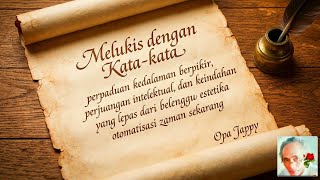
Lukisastra lahir dari Pembiasaan Melukis dengan Kata-kata, yaitu menghidupkan imajinasi visual secara presisi pada pembaca tanpa menggunakan alat bantu gambar fisik. Setiap karya wajib memenuhi syarat,
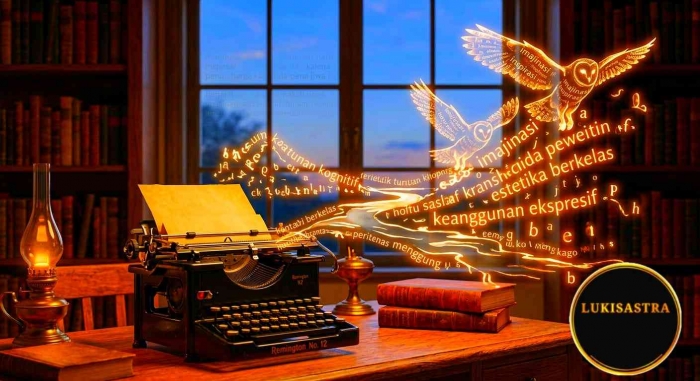
Almost everyone, guided by the context of their respective cultures, understands (even if they do not fully comprehend) what a Sastrawan (man of letters/writer) and a Seniman (artist) are.
In their general understanding, a writer is typically seen as someone whose profession is to produce (and deliver) rhythmic or poetic orations and narratives. Meanwhile, an artist is understood as someone who creates aesthetic works such as sculptures, statues, paintings, murals, and musical compositions (often called musicians), likewise as a career choice. This is indeed a division inherited from a long time ago.
But what if there are people who create such beautifully arranged words that they look like a "beautiful painting?" In the sense that he/she/they are able to dissolve the boundary between the visual canvas and the beauty of text.
They are the modern "Rupasastrawan" (visual-literary artists); both artist and writer, who do not use brushes or paint when creating beauty. Their primary medium is a sequence of vocabulary chosen with the highest aesthetic sensitivity. In their hands, language does not end as a tool for verbal communication, but transforms into a visual medium that radiates color, shadow, and perspective within the mind of the reader. This is what is called Lukisastra.
Lukisastra did not appear in an instant; rather, it was born from the ability and skill of Painting with Words (through long-standing habituation). Lukisastra is a neologism or a new diction (from and by Opa Jappy); it is also a new aesthetic manifesto.
Lukisastra positions language not as a servant of meaning, but as a medium. Thus, Lukisastra enriches Indonesian literacy and offers a new way of "enjoying" text in the digital era, while serving as a reminder that the magical power of true literature lies in the depth of its creator's soul.
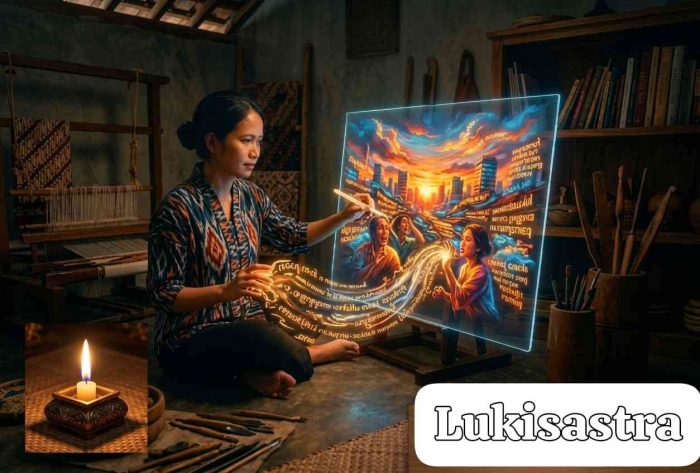
Lukisastra does not write ordinary descriptive prose. Instead, it produces aesthetic works; every sentence is composed like a brushstroke on a digital canvas. For example, when writing about humanism, social criticism, or reflections on life and living, the reader does not merely read the text, but is invited to "see" and feel the visual atmosphere of the issue being raised.
This beautiful integration between profound literary narrative and visual power fills the broken chain between the Traditional Writer and Artist; that void is filled by Lukisastra, the modern multimedia artists. Lukisastra serves as the link that connects the wholeness of the Writer's and Artist's Necklace.
Lukisastra is a new paradigm in the relationship between text and form. It is a manifesto stating that the boundaries of traditional art are not collapsing, but are instead being reinforced to prevent them from crumbling due to "AI literary products that lack soul and human emotion."
Lukisastra, through Painting with Words, acts as a "painter of the soul" who uses language as color pigments. Lukisastra brings the reader into an atmosphere where words function as digital brushstrokes, triggering an independent visual imagination within the reader's cognition. At the same time, it proves that language possesses a spatial dimension.
In the context of modernization, Lukisastra is highly relevant to today's digital era---an era where human attention has shifted to visual media, causing conventional literature to often be deemed "dry." Lukisastra arrives as a form of rejuvenation for digital literature. It offers a new way to enjoy text, turning reading into a dynamic visual journey.
Lukisastra enriches the treasury of Indonesian literacy by offering a fresh perspective, crossing media boundaries, and reweaving the artistic links that were once separated.
Lukisastra proves that a true writer is also a painter of the soul. It successfully breaks through the boundary of conventional literacy, rejuvenating the world of digital literature, and showing that words possess the magical power to vividly paint the reality of life and living without a single drop of paint.
 Lukisastra | Opa Jappy