

Welcome to CurioAnimusID — where history, mystery, and the unexplained come to life. We explore fascinating stories from the past, forgotten historical events, ancient civilizations, mysterious legends, strange predictions, myths, and unsolved mysteries from around the world. Through cinematic storytelling, compelling narration, and immersive visuals, CurioAnimusID takes you beyond the surface of history — uncovering the stories, strategies, mysteries, and hidden details that shaped our world. From ancient wars and legendary figures to forgotten civilizations and unexplained events, every story is presented to spark curiosity and invite you to see history from a different perspective. If you are fascinated by history, mystery, ancient civilizations, legends, and the unknown, you're in the right place. Subscribe to CurioAnimusID and explore the stories that history left behind.
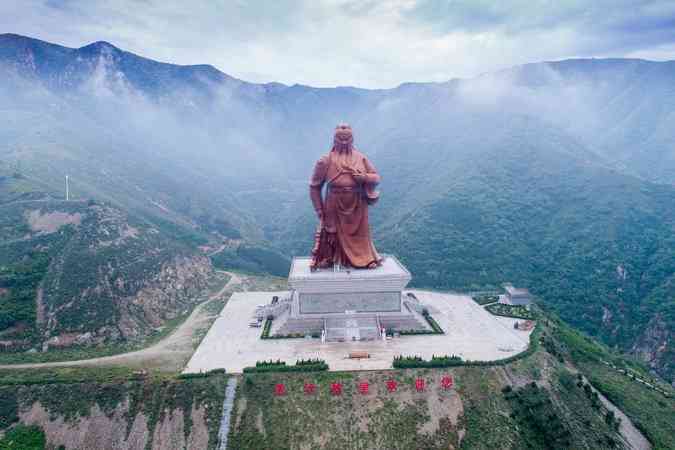 A recent photograph of the Guan Yu statue in Yuncheng, Shanxi, China, taken in 2017. Guan Yu was one of the "Five Tiger Generals" of the Shu Han dynasty. He was also the sworn brother of Liu Bei, the first emperor of the Shu Han dynasty during the Three Kingdoms period. Guan Yu was eventually ensnared and captured; he was sentenced to death after refusing to surrender. Fearing retaliation from Liu Bei, Cao Cao---to whom Guan Yu's severed head had been sent---arranged for his burial. At the time of his capture, Guan Yu was taken alongside his eldest son, Guan Ping, to the center of Sun Quan's camp. As he was being led away to face execution, Guan Yu simply laughed. The executioner, upon looking at Guan Yu, became so terrified that he dared not carry out the sentence. With no ordinary soldier willing to perform the act, General Pan Zhang () stepped forward and, using the Green Dragon Crescent Blade (Guan Yu's own weapon), beheaded him. Guan Yu perished in 219 AD at the age of 60. Cao Cao, who had long held great admiration for Guan Yu, had his head interred with a body crafted from sandalwood, conducting the burial with full honors and deep respect. Guan Yu's tomb is located in Henan Province, approximately 7 kilometers north of the city of Luoyang. From a distance, the site resembles a small hill surrounded by lush cypress trees---a symbol of Guan Yu's spirit, which remains undying and eternal through the ages. Over the course of thousands of years, these trees have grown into a dense forest, leading to the site being named "Guan Lin" (), or the "Forest of Guan." The tombstone itself was a gift from an emperor of the Qing dynasty (Emperor Jiaqing, circa the 1800s), presented during a restoration of the tomb. Near Guan Lin stands a memorial temple dedicated to Guan Yu, constructed during the Ming Dynasty. The temple showcases exceptional craftsmanship in both its architecture and intricate carvings, making it a popular destination for tourists from both within China and abroad. Another memorial temple for Guan Yu is located in Jiezhou, Shanxi Province. Jiezhou---known as Hedong during the Three Kingdoms period---is the birthplace of Guan Yu. The temple has undergone several expansions and renovations; it boasts stunning architecture and design, and remains one of the most well-known tourist attractions in Shanxi. (Photo: nytimes.com)
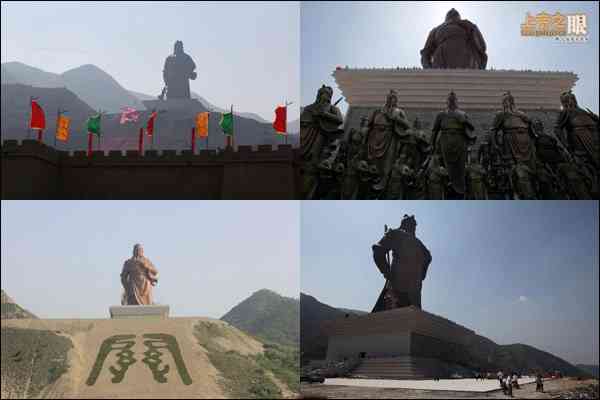 The world's largest statue of Guan Gong---also known as Guan Yu, who is revered as a deity in both Buddhism and Taoism---is located 13 kilometers southwest of Yuncheng City, in Changping Village, his birthplace. Standing at a total height of 80 meters (comprising a 61-meter bronze figure atop a 19-meter pedestal), it is currently the largest and tallest statue of its kind in the world. Guan Gong is typically depicted in full battle attire---sometimes shown reading a book---accompanied by his adopted son, Guan Ping, who holds an official seal, and his loyal bodyguard, Zhou Chang. Zhou Chang is portrayed with a dark, bearded face and carries Guan Gong's signature weapon: a *guandao* (pole blade) known as the "Green Dragon Crescent Blade" (*Qinglong Yanyuedao*). According to the first chapter of *Romance of the Three Kingdoms*, this blade weighs 82 *jin* (catty). During the Eastern Han Dynasty (25 BC--220 AD) and the Three Kingdoms period (220--280 AD), one *jin* was equivalent to approximately 220 grams, making the blade weigh about 18 kilograms. In Buddhist practice, Guan Gong is often venerated independently, without attendants. He is frequently identified as *Qielan Pusa* (Sangharama Bodhisattva)---a guardian *bodhisattva*---often appearing alongside *Weituo Pusa* (Skanda Bodhisattva). Statues of Guan Gong generally depict him as a mature, fatherly figure with a long beard, a dark brown complexion, and deep red lips. "He possessed phoenix-like eyes and thick, silkworm-like eyebrows." His feast day (his birthday) is commemorated on the 24th day of the 6th lunar month, while the 13th day of the 1st lunar month marks the day of his ascension (his deification). Meanwhile, the commemoration for Guan Ping (who holds the title *Ling Hou Thi Zi*) falls on the 13th day of the 5th lunar month, and the commemoration for Zhou Chang (General Zhou) takes place on the 20th day of the 10th lunar month. As Chinese immigrants moved out of China, the veneration of Guan Gong spread to the various countries where these migrants settled. In places such as Hong Kong, Taiwan, Malaysia, Singapore, and Indonesia, there are numerous temples dedicated to the deity Guan Gong. In Indonesia, the largest temple specifically dedicated to Guan Gong---spanning an area of 4 hectares---is the Kwan Sin Bio (*Guan Sheng Miao*) temple in Tuban, East Java. In temples dedicated to Guan Gong, a groom---referred to as *Ma She Ye* or *Tuan Ma*---is also typically venerated. He is tasked with caring for Guan Gong's steed, known as *Chi Tu Ma* (Red Rabbit), which was said to be capable of traveling 500 km in a single day without ever growing weary. Source: NYTimes
Zhuge Liang's Secret Fleet Is Moving... But Why? | Red Cliffs EP. 13
The third day has arrived. A thick fog covers the Yangtze River, and Zhuge Liang finally makes his move.
A mysterious fleet of Wu warships advances toward Cao Cao's forces. Lu Su is worried, but Zhuge Liang remains calm.
Is this a dangerous gamble... or a brilliant trap?
The enemy has noticed the approaching boats. But what happens next could change everything.
Will Zhuge Liang's strategy succeed?
Can Cao Cao see through the deception?
Watch until the final second---and get ready for Episode 14!
What do you think Zhuge Liang is planning? Share your theory in the comments!
RED CLIFFS: STRATEGY OF THE DRAGON
Episode 13 --- THE SILENT FLEET